

ATV's choice of TV aerial (and why we chose them)
Also see ATV’s choice of FM / DAB aerials
The subject list :
The Great Wideband Debate incl :
- Benchmarked aerials
Our TV aerial recommendations incl :
- DM Log / DM18 Log (Widebands)
- Log36PW T group / Wideband
- Grid Wideband aerial
- Yagi 10 K
- Yagi 18 A / B / K / E
- XB10 A / B / K
- DY14 Wideband
- XB16 A / B / K
Aerial dimensions and wind load incl :
- Windloading of satellite dishes
Aerial box dimensions
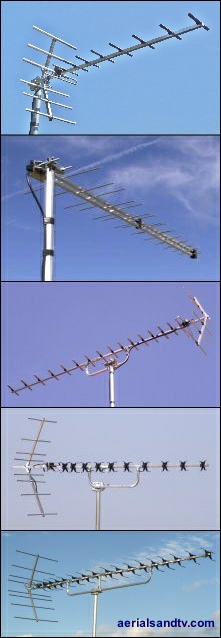
ATV’s Choice Of Aerials & The Great Wideband Debate
This article has had to be rewritten because, due to the 700MHz clearance, wideband aerials will be obsolete from June 2022 when the whole TV band will be K group, i.e. it will only go up to CH48.
When I say obsolete I do not mean wideband aerials will no longer work, what I mean is their wideband capability will not be required. As discussed on the relevant page wideband aerials are a design compromise in that they work right across the whole CH21 to CH68 UHF band but in order to do so they do not give as much gain (signal) as a grouped aerial. This is generally only significant in poor signal areas (or medium signal areas for loft aerials), but if your signal is poor you should be using a grouped aerial, particularly for A group transmitters. On the subject of which, after the 700MHz clearance many more transmitters will be A group.
There is another potential fly in the ointment with wideband aerials, the high power 4G/5G transmissions, which, in some locations, may need filtering out. Well a B or K or (especially) A group aerial will avoid picking up a certain amount of the signal [which is from CH61 upwards] in the first place, and that may obviate the need for filters at some locations which may otherwise have needed them.
Benchmarked Aerials
We are sometimes asked whether our recommended aerials are “CAI Benchmarked” (though this term has been superseded by : "product certification scheme") . The simple answer is that some are and some aren't. Why ? Well, as with wideband aerials, this is not a simple question..... We agree that any attempt to encourage the manufacture and sale of better quality aerials is a good thing. Most Benchmarked aerials are of good quality, though structural durability is not taken into account in the scheme. In fact it has to be said that a few of them are “Bacofoil” aerials, no names no packdrill.....
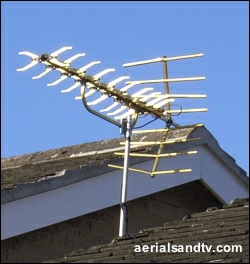
Oh go on then, SLX/Labgear/Philex. [link]
Incredible as it may seem this aerial is actually Benchmarked..... But it’s not just the fact it’s a “Bacofoil” aerial, it’s bleedin’ gold for God’s sake !
Who would want one of these on their house ?
That’s the question.
Answers on a post card to :
A.T.V,
“1970s TV Competition Reminiscences”,
419 Langsett Rd,
Sheffield,
S6 2LL
We didn’t like having to send in postcards did we ?
Ohh no. What we really wanted to do was pay through the nose to waste our time phoning up premium rate phone lines instead !
Anyway, back to Benchmarked aerials. But, and it’s a significant but, just because an aerial is not Benchmarked does not mean that it is in any way inferior. Quite apart from the fact that there are four different levels of Benchmarking (so you have to be specific about what you mean be Benchmarked aerial) most grouped variants of the same model of aerial are not Benchmarked whilst the wideband version is Benchmarked ! Bearing in mind that over its designed for frequencies the grouped model will perform better than the wideband (sometimes by a large margin) this seems somewhat bizarre. With a bit of background information the explanation is not hard to comprehend. It costs the aerial manufacturers around one thousand pounds to put an aerial through the Benchmarking process so they will only do this for products which they will sell a fair number of and/or make a fair bit of money on. When you realise that widebands outsell grouped aerials by a large margin (most aerial suppliers - to the public - and all DIY shops only sell widebands) it all becomes clear.
In short, a version (usually the wideband) of all our recommended aerials is Benchmarked.
But, as far as I’m concerned, it’s irrelevant, I’ve done my own tests thanks.
Also see “the wrong aerial for Crystal Palace” (or any A group transmitter)
Our TV Aerial Recommendations
We sometimes get people asking to buy “the best aerial you stock, regardless of cost”. Unfortunately, contrary to what others may tell you (particularly if they’re trying to sell you an expensive antenna.....), there is no such thing as a “best aerial”. It all depends on the signal strength in your area and (if you’re in a poor spot) which transmitter you are on. The Log Periodics are amongst our cheaper aerials but if you live in a strong or medium signal area they are the amongst the best aerials to use (the Yagi 18K is pretty good though ! ), “better” than an XB16 ! Similarly if you live in a marginal area but can utilise a grouped antenna, a grouped Yagi18 is more suitable than a huge wideband aerial, despite being much cheaper.......
Basically I have made a decision to only stock the best aerial of each type that anyone might require, and weeks of testing (by my good self) ensures I can say this with a certain amount of authority. Therefore the simple answer is that all of our aerials are the best ! In fact any aerial (or indeed any product) we stock will be a top notch product, because, to put it simply, if it wasn’t we wouldn’t stock it. Incidentally, unlike most suppliers, we endeavour to provide spare parts for aerials purchased from us.
After much experimentation and research we have settled on TV aerials listed below.
(also see ATV's choice of FM/DAB aerials)
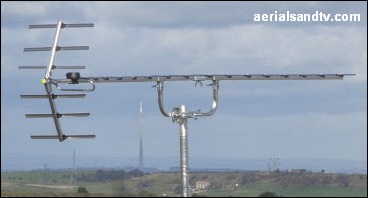
Picture is of a Yagi18B at our test site,
note Emley Moor transmitter in the background.
DM Log Periodic Wideband (For touring caravans / boats)
Yagi10 K (For good to medium signal areas)
Log 36 Log Periodic T Group / Wideband (For medium to medium/poor signal areas)
Grid aerial (Wideband, specialist aerial for medium signal areas)
Yagi18 A / B / K / E (For poor signal areas)
XB10 A / B / K (For poor signal areas)
DY14 Wideband (For poor signal areas)
XB16 A / B / K (For the most marginal signal areas)
See our advice for which aerial to use with which (main) transmitter.
DM Log Periodic Aerial (sold here)
The perfect aerial for reasonable (strong to medium) signal areas. Only available in wideband.
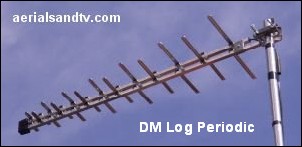
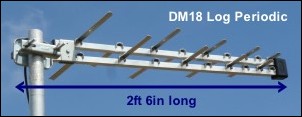
Recommended for touring applications (caravans & boats etc), either the standard DM Log aerial (a 26 element) or the shorter 18 element version, the DM18 Log. The latter is 12in shorter at only 2ft 6in long and only has 1 to 2dB less gain than the standard DM Log. It is suitable for those requiring the smallest aerial in a reasonably strong signal area, but particularly since switchover it will actually work fine in many locations.
Both aerials come with a heavy duty tilting clamp (for poles up to 2in) which facilitates elevating the front end of the aerial, we recommend slightly tilting up the front of all (outside installed) Log Periodic type aerials. As far as I’m aware the DM Log is the only model of Log Periodic on the market which is fitted with a tilting clamp, somewhat surprisingly really.
For gain figures see test results on the product pages.
For dimensions see table.
See Aerial Reports for the DM Log Periodics
Approx wind loading (at 80mph) = 35N [18 element = 30N] (greater if vertically polarised)
From Jun 2019 the DM logs have spun galvanised clamp plates ! This means that, although the finish isn’t as smooth, they’re very much more rust resistant.
NOTE : we will send any customer who has bought a DM log in the past (and is suffering from rust on the clamp plates) a pair of the spun galv ones free. Just contact us with proof of purchase.
There is no time limit on this offer. [Link]
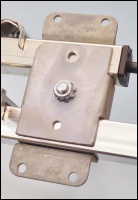
The DM18 is the shorter version of the DM Log at only 2ft 6in, it has slightly less gain but is just as well made and (our version) comes with a heavy duty tilting clamp.
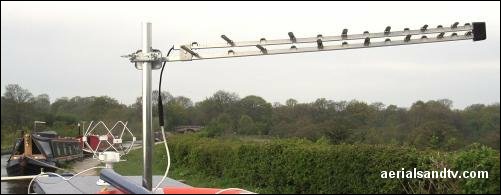
The DM Log’s 6 inch trailing lead (c/w rain proof slide over cover) makes it even more suitable as a touring aerial. A full length lead is then attached to this “tail”.

The strong (and repairable, see below) construction of the DM Log together with its relatively compact size also make it perfect for use on boats and caravans as well as on houses. In my opinion, and from personal experience, there is no aerial more well suited to boats and caravans than this one.
Maintaining your DM Log aerial
When using the DM log for a touring aerial (caravans / boats) it’s going to get battered about but, fortunately, it’s all metal so is easily repaired. We recommend regularly checking that all the elements are a firm “tight” fit because loose fitting elements on a Log Periodic can affect its performance (unlike on a Yagi where they don’t, in fact, have to make any electrical contact with the boom at all) so try to ensure the screws are all tight. If you accidentally strip the threads simply fit a slightly larger self tapper, in gauge NOT length, particularly in the boom where the cable runs, you do not want to screw right through the cable or you may not get any signal at all (see cable testing on a Log) ! Also check the element “over clips” are tight, use a large pair of pliers to keep the latter in firm contact with the booms. The DM Log can be “opened out” quite easily at the clamp end to facilitate access to the lower element screws and or clips.
We have had the odd report of some log periodic aerials losing signal when it rains hard. As yet we have never got to the bottom of this but suspect it may be water filling the boom(s) of the aerials, if our theory is correct this would only happen if the aerial's boom(s) were sealed at the clamp end and also was being used horizontally polarised. A possible solution to this is to drill - about 6mm - a hole in the bottom of the boom near the clamp end so any water which seeps in can then drain out. The best place on a DM Log would be under the boom clamp plates to minimise water ingress when vertically polarised. Take great care not to accidentally drill into the cable though !
Log 36 Aerial (pre-wired) (sold here)
The perfect aerial, along with the slightly higher gain Yagi18K, for medium signal areas. In most cases (90% of installations ?) you can’t go far wrong with a Log36 or a Yagi 18K TV aerial, particularly if you need a T group / wideband aerial. If you’re still short of gain then, and only then, try adding a variable gain (capable of being turned down to a low level) mast head amp.
NOTE : The version sold from Jun 2018 on, is, unfortunately, pre-wired. In order to improve the waterproofing of the F conn joint we supply 1ft of self amalg tape.
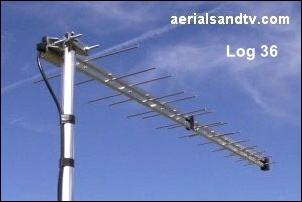
The Log36 is tuned to help reduce interference from the mobile phone signals, 4G/5G transmitted just above the TV band since 2013, though it must be said a filter is generally the most effective way to combat that problem. Log36s are only available in T group / wideband (c/w clamp [non tilt] for poles up to 2in). See wiring up a Log36.
We recommend that for outside installs all Log Periodic aerials tilted up at the front end.
For gain figures see test results on the product page. For dimensions see table.
See Aerial Reports for the Log36 / Log40
Approx wind loading (at 80mph) = 45N (greater if vertically polarised)
Yagi 10K v Log36 v Yagi 18K
103cm long : low wind load -- 131cm long : low wind loading -- 175cm long : medium wind loading
End mounted (more suitable for some installs) -- End mounted -- Centre mounted (less twisting force in the wind)
Exceptionally sturdy aerial -- Medium build quality -- Very sturdy aerial
Low to medium gain (higher above CH40) -- Medium gain (lower above CH50) -- Medium to high gain
Hardwired (= better) -- F connector wired -- Hardwired
Tilting heavy duty clamp -- Non tilting clamp -- Tilting heavy duty clamp
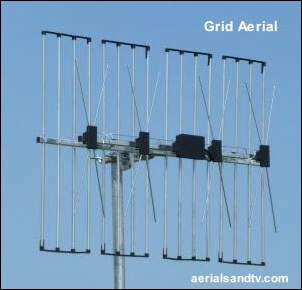
Grid TV aerial (Sold here)
The Grid is a specialist aerial most often used these days when trying to reduce the signal from a transmitter directly behind the antenna. In addition, because of its wide but short construction, it can also be useful for installations requiring an antenna of that shape.
See article on the Grid aerial.
For its performance see its gain curve on the shop page.
For the aerial’s dimensions see table.
Approximate wind loading (at 80mph) 75N
Yagi 10K TV aerial (Sold here)
This is a shorter 10 element (8 director) version of the superlative Yagi18, for more details of the latter see below.
Being smaller with fewer elements it obviously has less gain than the equivalent Yagi10K (about 2dB less). On the other hand it has lower wind loading (though the Yagi18 only has a medium wind load anyway) and is end mounted which may be significant for some installs.
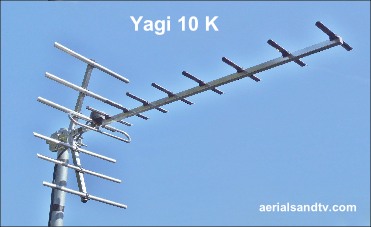
If, relative to other aerials, the Yagi 18 is built like a tank, then the Yagi 10 must be built like a nuclear bunker. Remember it has the same heavy duty components as the Yagi 18 but in a smaller aerial (i.e. lower wind load). We're told the Yagi18 can withstand a 110mph wind, so I'd have thought it'd take a hurricane to damage the Yagi 10K.....
The aerial has a balun and comes with a heavy duty tilting clamp .
We recommend the Yagi 10K for good to medium areas of reception for all transmitters.
Technically this is a K group aerial, but post 700MHz clearance, it is effectively a wideband.
For the aerials gain curve see the aerial's sales page.
For dimensions see table.
Yagi10K Approx wind loading (at 80mph) = 55N (greater if vertically polarised)
Yagi 18 TV aerials (Sold here : A, B, K and E group)
Our preferred model of Yagi18 Aerial, which is available in A, B, K and E groups.
These particular antennas have significantly better build quality than any X Beam aerial I’ve seen, though for loft mounted installs we'd recommend the XB10s because they're a bit shorter.
The Yagi18, a great aerial.
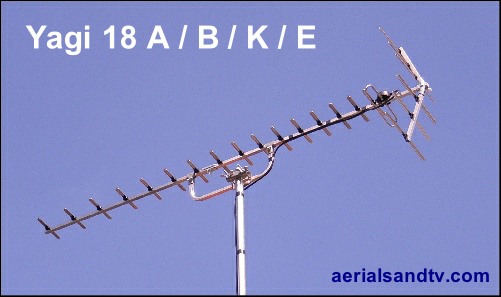
We recommend our grouped Yagi18 for poor areas of reception. Despite being significantly smaller (wind loading wise) than most “high gain” wideband aerials, the A group version will blow away any wideband antenna, and the B group’s gain is as high as any wideband irrespective of size. The version we stock has the best performance of all the Yagi18s on the market, it has a "balun", a cradle and a heavy duty tilting clamp for poles up to 2in. Last, but by no means least, these Yagi18s are one of the sturdiest aerials on the market. In fact we sold one to a chap in Orkney and he reported it was still fine after a 110mph wind ! Another customer stated "this Yagi18A makes all other aerials look like cheap, tacky TOYS!" Many people replace Bacofoil aerials with these and are amazed at the difference in build quality, and you will be too.......
I’ve always liked them, they’re one of my favourites.
For gain figures see gain curves on the relevant product page : A, B, K and E group.
For dimensions see table.
See Aerial Reports for the Yagi 18A, Yagi 18B, Yagi 18K and Yagi 18E.
Yagi18 Approx wind loading (at 80mph) = 75 to 85N (greater if vertically polarised)
Note that since the 2013 4G clearance the Yagi18K is effectively a wideband, i.e. it’s suitable for any transmitter, though a grouped Yagi18 (particularly the 18A) will perform better.
Examples of the major transmitters which can utilise a grouped Yagi18.
XB10 TV Aerials (Sold here : A, B and K group)
The XB10A / B / K is an alternative aerial to the Yagi18 for poor reception areas. It has marginally more gain than a Yagi18 and is well made for an XB type aerial in fact it's in a different league from a Bacofoil (though nothing compares to a Yagi18 in that regard). We recommend an XB10 over a Yagi18 for a loft aerial install due to the more compact nature of the former. Unlike the Yagi18s the XB10s can be end mounted but we would not recommend that in an exposed location and/or would advise strong mounting hardware plus the use of saddles.
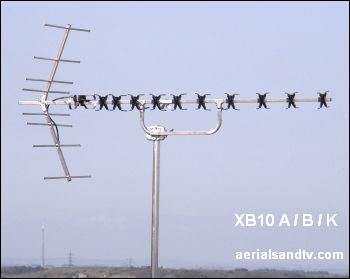
The XB10s come with a cradle and heavy duty tilting clamp for poles up to 2in.
Due to wind loading considerations if fitting to a 10ft pole we advise using the 2” variety.
For gain curves see each products page : A, B and K group.
For dimensions see table.
See aerial reports for XB10A, XB10B and XB10K.
XB10 Approx wind loading (at 80mph) = 95N (greater if vertically polarised)
Examples of the major transmitters which can utilise an XB10A / B / K.
DY14 Wideband MK2 (Sold here)
(Mk2 from 2015)
If you are unsure of the transmitter you will use, but you are sure you need a “high gain” aerial (and most people don’t need one....) then this is the antenna I’d go for.
Note that the DY14WB is only medium gain for A group transmitters (e.g. Crystal Palace & Rowridge), no wideband aerial will be high gain for the A group and most perform worse than the DY14WB down at those frequencies.
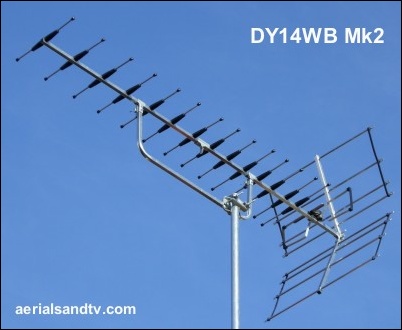
We still recommend a high gain wideband over a T group despite the fact widebands are technically obsolete. This is because all T groups start dropping off in their gain curves in the mid high CH50s to try and minimise 4G interference, (though I’m sceptical if they’re much good at it….). But if you’re in a poor spot you need high gain in the high 50s ! So I’d go for a high gain wideband and if you do have 4G problems I’d get a filter, the latter will work better at preventing 4G interference anyway. This is a particularly good strategy whilst good quality filters are still available free from at800 ! !
If you are on a K group transmitter, and in a poor spot, we recommend our K group aerials.
The DY14 Wideband is a “Double Yagi” type aerial and is well made, in fact these antennas have better build quality than the more common X Beam type aerials. The DY14WB has a "balun", a cradle and a heavy duty tilting clamp for poles up to 2in.
Size for size the DY14WB is the best high gain wideband I’ve ever come across, in fact its performance is even reasonable in the A, though obviously a decent group A aerial (or our XB16 group B) will have more gain in the relevant groups frequencies.
Due to wind loading considerations if fitting to a 10ft pole we advise using the 2” variety.
The DY14 is a good choice for someone needing to fit a high gain wideband aerial in the loft because it’s only 5 ft long, which is pretty compact for an aerial with this amount of gain.
For gain curve see the DY14WB's shop page.
For dimensions see table.
See Aerial Reports on the DY14WB
Approx wind loading (at 80mph) = 90N (greater if vertically polarised)
The XB22WB was discontinued in 2013, we recommend the DY14WB Mk2 in its place.
XB16 aerials (Sold here : A, B and K group)
These are the highest gain aerials I know of, certainly the highest gain I’ve tested.
Do not confuse these aerials with smaller 10 bay A / B / K group X beam type aerials.
XB16 up at our test site.
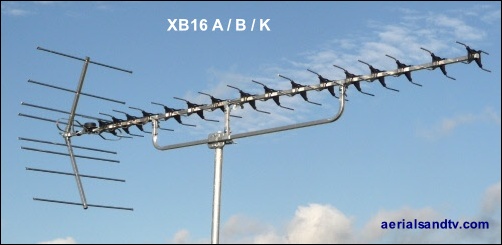
In the weakest signal areas we would fit the XB16 in group A, group B and group K. These are all X Beam type antennas but they are still of reasonably strong construction, unlike some of that type, and all come with a cradle and a heavy duty tilting clamp (for poles up to 2in).
For gain curves see each aerial's shop page : A, B and K group.
For dimensions see table.
See Aerial Reports for the XB16A XB16B XB16K
Approx wind loading (at 80mph) = 120N to 140N (greater if vertically polarised)
NOTE, somewhat surprisingly XB16s wind loading figure is actually lower than that of Triboom aerials ! Despite the latter having less gain ! ! Despite that, if fitting an XB16 on a 10ft pole we strongly advise using one of 2” diameter.
The XB16E is NLA from 2017, we recommend a DY14WB instead.