
419 Langsett Rd
Hillsborough
Sheffield
S6 2LL
© 2012 Justin Smith A.T.V
All Rights reserved
Free delivery for orders over £100, Online or by Phone           Tel : 0114 285 4254                 Contact Us

Main Page List

View cart button

Scholars welcome !

Online Shop

Online Shop

Online Aerials

Aerials Shop

Online Cable & Leads

Cable & Leads Shop

Online Poles & Brackets

Poles & Brackets Shop

Online Splitters & Amps

Splitters & Amps Shop

Planning Your Install

Aerials

Aerials

Loft Aerials

Loft Aerials

Boat / Caravan Aerials

Boat / Caravan Aerials

ATV`s Choice Of Aerials

ATV`s Choice Of Aerials

TV Aerial Tests

TV Aerial Tests

Aerial Reports

Aerial Reports

Aerial Positioning Tests

Aerial Positioning Tests

Poles & Brackets

Poles & Brackets

How To Attach / Wire Up Plugs, Wall Plates & Aerials

Cable & Leads

FM / DAB Radio

FM & DAB Radio

Digital TV

Digital TV

Nationwide Transmitters

Nationwide Transmitters

Digital Transmitters

Transmitter Maps

Transmitter Maps

Cowboys` Locker

Cowboys` Locker

Splitters and  Amps

Splitters & Amplifiers

A.T.V Home / Index

A.T.V Home / Index

Cable & Leads

Wiring up plugs & aerials

Appendix

Appendix

Pontop Pike was opened in 1953 (though the date on the buildings at its base is 1955 ! )

to transmit BBC television on the "old" VHF 405 line system. Transmission of this signal

finally ceased in 1985, though since 1966 Pontop had been broadcasting (in colour) on the UHF 625 line system. It is situated 10 miles SW of Newcastle and its population coverage

is approaching two million. The transmissions are received in most areas of the North East including Newcastle, Sunderland, Durham, Hartlepool, Darlington, Stockton and Middlesborough. Bilsdale would probably be the main choice for the last three, but in the end transmitter choice is all down to "line of sight"......

The mast is a cable stayed spaceframe with height (to the base of the transmitting array`s shroud) of 134m, so the tip of the mast is probably another 20 or so metres above that,

also see How High is High ?

The transmitter broadcasts the four main analogue channels at 500kW (and that is a lot

of power) though it doesn`t transmit C5 - on analogue - that come`s from Burnhope which

is four miles to the SE.

Digital / Freeview power is 10kW apart from MUX6 which is 8kW. Being a main transmitter Pontop is Horizontally polarised and it is C/D group. It has twenty six smaller repeaters to improve its coverage in poor signal areas. The channel planners managed to fit in all the Digital MUXES within this band so, with luck, an aerial change should not be required to pick up Freeview, see Pontop Pike graph.  


According to Ofcom Pontop Pike is nominally omni directional for all the Digital MUXES.


DSO is due on the 12th and 26th Sept 2012. and it has been confirmed by Ofcom that Pontop will remain a C/D group.

At switchover Pontop`s digital power output will increase from the pre DSO 8 to 10kW output up to the post DSO level of 50 to 100kW (the latter for the PSBs).


Pontop Pike is planned to transmit a pre switchover low power HDTV MUX (on CH63 at

10kW) from Feb 2010. Due to co-channel interference issues being less severe at Pontop than at other transmitters its radiation pattern will be nominally omni directional.

You will need a Freeview HD set top box though, due on the market from 2010.


There are two interleaved spectrum channels allocated to Pontop Pike, CH 51 and 56,

which are both within the C/D group.In addition there is a possibility of 2 or 3 more MUXES being transmitted between CHs 31 and 37. Some of these would only be receivable from a C/D group in a good signal area, fortunately there are alternatives.


For Pontop`s frequencies see its Channel Allocation Guides for before & after the DSO. The guides also include the same information for some of the other transmitters in Pontop`s coverage area, namely Bilsdale, Emley Moor, Chatton, Fenham, Newton, Haltwhistle, Alston, Shotleyfield and Weardale. The Channel Allocation Guides can be very useful in the diagnosis of co-channel interference problems and can also be invaluable if you are trying to find a spare channel for a modulated output (e.g. for a Sky box or CCTV system) to be added to your TV setup/distribution system without suffering from co-channel.

Back to the top

Burnhope transmitter was opened in 1959 to broadcast the "new" ITV channel on the

VHF system which it continued to do until 1985. The fact that Burnhope is only 4m SE of Pontop is no accident because it was intended to be effectively "co-sited" and therefore it would be picked up by those with their antennas trained on the BBC transmitter. This trick was used again when C5 came out in 1997 and Burnhope transmits (only) Channel Five

- on analogue - at 50kW. Those living NW or SW of the two transmitters will obviously have greater problems in picking up both, particularly from locations less than 10 miles from them. The latter figure will obviously vary according to the acceptance angle of your aerial, "high gain" types having a smaller acceptance angle. Incidentally this same double transmitter scenario was originally also used at Crystal Palace / Croydon,

Sutton Coldfield / Lichfield and Holme Moss / Emley Moor. The first two pairs also use the former ITV transmitters to broadcast C5. Burnhope is located about 6m WNW of Durham

(at NZ 184 474) and just like Pontop Pike it is a cable stayed spaceframe with five stay levels, though the mast height is 229m, which is somewhat taller than the BBC structure. One assumes that Burnhope will cease TV transmission when the analogue signal is

turned off in 2012.


At one time there were numerous railway lines around Pontop Pike but now if you want to visit this area it`s a car or a bus.The ex Stanhope & Tyne Railway used to run about half a mile away and this was one of the first built in this country in 1834. It was the last to

survive in the area but when the steel works at Consett shut in 1980 the line soon followed, closing in 1985.

Beamish the extensive heritage site/museum is only about four miles away, it opened in 1971 and has been expanding ever since. It`s well worth a visit but there`s so much to see that I`d plan to stay all day if I were you.

It`s actually good value if one considers that everything is "free" once you get in,

the opposite of, say, "Center Parcs" (SPX) for instance......


External links


Pontop Pike transmitter page on MB21

Pontop Pike transmitter page at The Big Tower

Pontop Pike transmitter page on Wikipedia
 

Digital UK details of Tyne Tees transmitters

Ofcom Tyne Tees transmitters details


Burnhope transmitter page on MB21

Burnhope transmitter page at The Big Tower

Back to the top

Base buildings at Pontop Pike. The date on the crest is 1955 though the mast began TV transmissions in 1953. Maybe it was something

to do with the start of VHF/FM radio

broadcasting which did begin in 1955.


Note the style of the structure, only marred by the security shutters and so forth needed to combat the moronic members of our society......

The whole thing, including the impressive crest,

has gravitas. Nowadays you`d just get a plastic

sign which would probably be in grammatically

inaccurate lower case *. Oh to be trendy......

On the subject of gravitas, when Pontop was

built TV news readers had some. You`d get a gentleman (or lady) behind a desk, not a pair of them poncing about like a pair of love struck teenagers.

Quite apart from anything else who is paying for

this under employment ? I say get rid of one of

them and cut the cost of the TV licence.......

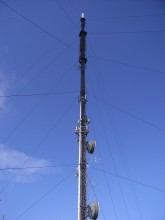
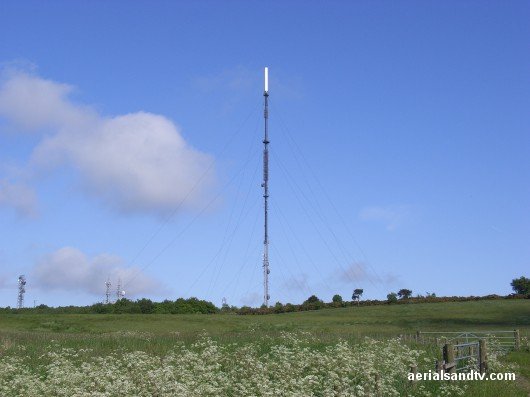
Pontop Pike TV Transmitter, from the SW.  

Pontop Pike viewed from Burnhope TV transmitter.

Burnhope transmitter.

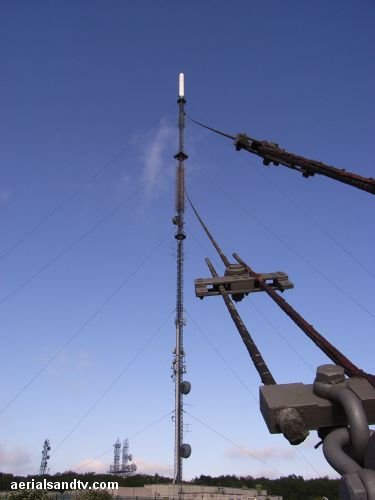
Pontop Pike television transmitter from an outer stay anchor.


See Pontop Pike`s  height in relation to other transmitters.

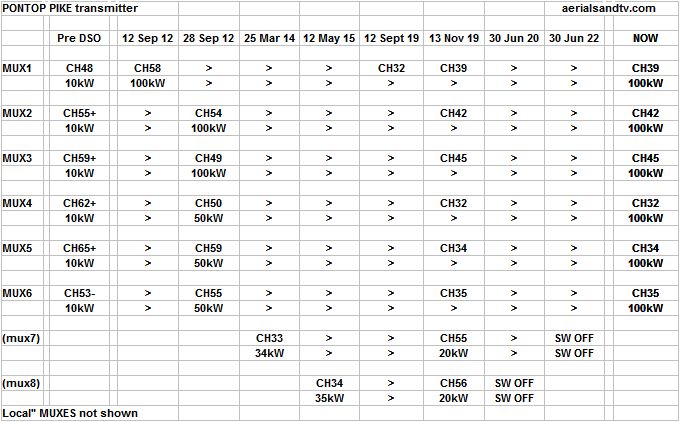
Pontop Pike`s TV frequencies/channels* for before DSO (above) and after DSO (below).  

Also check Pontop`s twenty six smaller repeaters


The frequencies given are for (most) digital MUXES, for analogue channels deduct 3MHz.
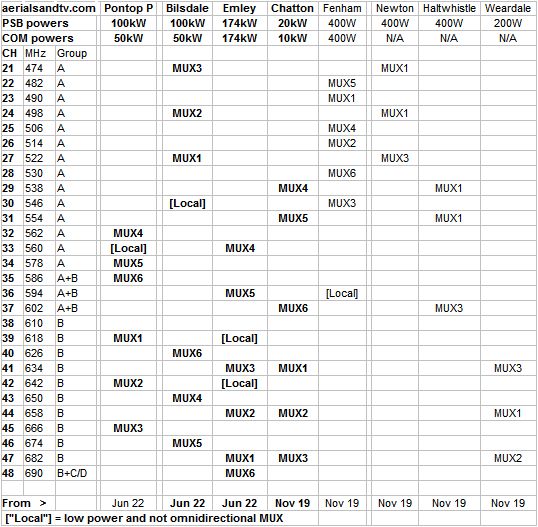
 

* There are a few retune events (temporary MUX reallocations) just before and after DSO which may not be shown on these tables.


Note the gaps in the table below for channels 31 to 35, 37 and 61 to 68, they`re reserved for “other uses”........

Back to the top

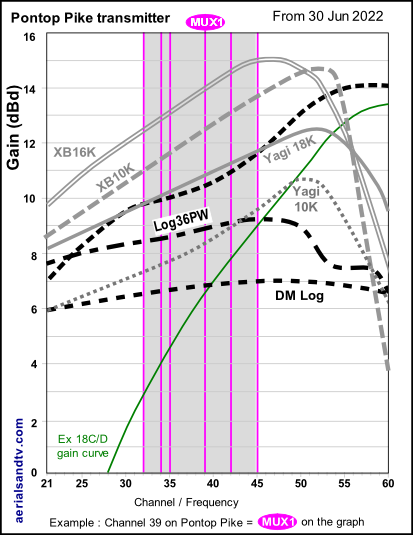
Pontop Pike`s channels in relation to the UHF TV band and the gain curves of the aerials

we recommend for it.   DM Log    Log40     Yagi18C/D     DY14WB     XB16E

Also see other relevant C/D group curves.

Back to the top

*  I know what you`re thinking, he`s a fine one to talk about “grammatically incorrect lower case” with his aerialsandtv.com, .......but that`s a URL !

Back to the top

Spectrum = Interleaved Spectrum Channels

Some post switchover MUX allocations (particularly CHs 61/62 and 49/50) may well be changed due to the 800MHz clearance.


If you`ve found this site informative and, hopefully, interesting as well,

please help us increase the number of people reading it.

Back to the top

Pontop Pike Transmitter                       OS Grid Ref NZ 148 526  

   (& Burnhope)                                                       (OS Grid Ref NZ 184 474)


Note, as work takes place on various digital transmitters (to prepare for the DSO) you may

experience problems, e.g. with certain MUXES disappearing. First try rescanning your

TV / set top box (do it manually if possible), but if this fails to work check on transmitter work

or call the reception advice phone numbers.   Also see basic digital fault finding.


Digital switchover at Pontop Pike is due on the 12th and 26th Sept 2012.

We are more than willing to give advice to those actually purchasing from us.  

Could those only seeking information please just find the answer somewhere on this site,

or ring an aerial installer local to them, or call the reception advice phone numbers.

Back to the top

Back to the top

Back to the top

Back to the top

Back to the top

For Pontop we recommend the DM log for strong signal areas, the Log 40 for

medium signal areas, the Yagi18CD* or the DY14WB for poor signal areas, and the XB16E for those with the most marginal signals. The dimensions and test performance of the aerials can be found on the relevant tables. If requiring a “high gain aerial” in the loft we recommend the DY14WB over the XB16 because of the former aerial`s smaller size.


* See "covering all eventualities"