
Black Hill Transmitter
Note, due to the new phenomenon of MUXICAL chairs you may experience problems with certain MUXES disappearing. First try rescanning your TV / set top box, do it manually if possible. If this fails to sort it check on transmitter work or call the reception advice phone numbers.
Also see basic digital fault finding.
All Black Hill's CHs stayed the same after the 700MHz clearance in Sept 2018.
Black Hill transmitter page jump links :
- Digital power output, aerial group and polarisation of Black Hill
- Our TV aerial recommendations for Black Hill transmitter
- Black Hill transmitter's graph (its transmissions v our aerial recommendations)
- Black Hill transmitter's channels/frequencies (including alternative transmitters)
Black Hill television transmitter was first opened in 1957 but the first mast was 230m high (see How High is High? ) and was replaced by a higher structure in 1961, the original was moved to Selkirk and is still in use. That 307m mast was itself replaced (between 2008 and 2010) by a new mast as the 1961 structure was deemed insufficiently robust to carry all the transmission antennas now required on it.
The transmitter has the fifth highest population coverage of any TV transmitter at around 2.5 million and it is located 14 miles East of Glasgow (for the sake of impartiality, that's about 25 miles West of Edinburgh! ). Most people in Glasgow, Coatbridge, East Kilbride, Motherwell and Paisley receive their transmissions from Black Hill, but there are those in Stirling and even in Edinburgh who also use Black Hill (rather than Edinburgh's more usual transmitter Craigkelly) if the local terrain or other buildings mean the line of sight is better.
Black Hill's channels
For the most up to date MUX to channel allocations etc put this postcode ML7 4NZ into the Freeview checker.
Also see Scottish Central region Freeview transmitters.
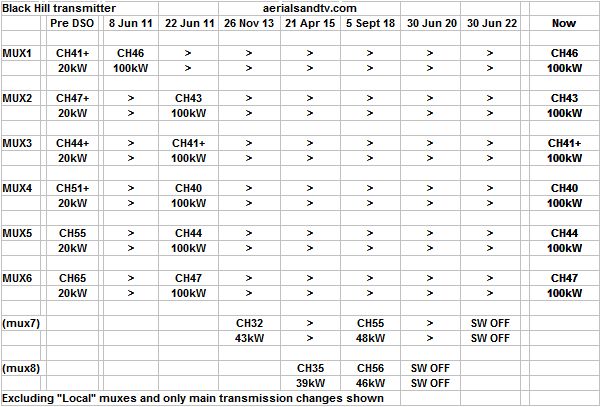
Black Hill is horizontally polarised. It was originally a B group for analogue, then temporarily became an E group (or wideband) whilst transmitting both analogue and digital, before reverting back to a B group at switchover in 2011.
Black Hill is a main transmitter and it has sixty four (including Torosay's twenty two) smaller repeaters to improve coverage in poor reception areas within its coverage area.
There is one "Local" channel allocated to Black Hill, CH30, this is mainly used for a local Glasgow TV channel. This channel can be picked up by all decent B group aerials.
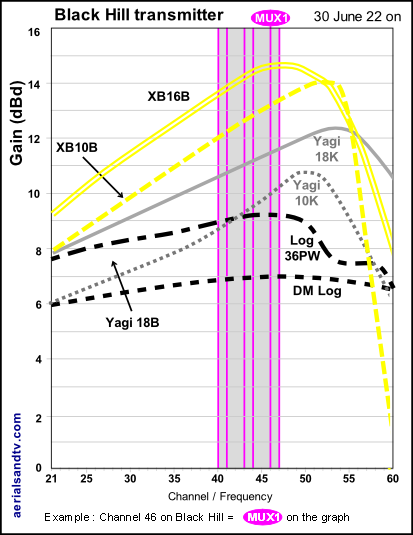
For Black Hill we recommend the Yagi10K for strong signal areas, the Log36 or Yagi18K for medium signal areas, the Yagi18B for outdoor installs in poor signal areas, the XB10B for loft installations in poor signal areas, and the XB16B for those with the most marginal signals. Unless you have a massive loft we’d normally recommend an XB10B for loft installs (over an XB16) due to smaller size of the former aerial. The dimensions and test performance of the aerials can be found on the relevant buy pages.
Those in poor reception areas, can take advantage of the superior performance of a B group aerial over a wideband. If you really need a "high gain" aerial (and most people don't) a decent B group aerial should be used. On the other hand if the signal is strong (or medium) then, by definition, it doesn't need a "high gain" antenna anyway ! Under these circumstances a Log Periodic should be fitted instead. See Black Hill's graph.
External links
Black Hill Transmitter page at MB21
Black Hill Transmitter page at The Big Tower
Black Hill Transmitter page on Wikipedia
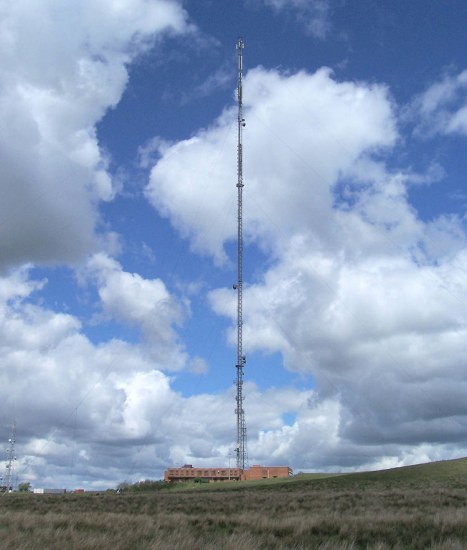
Black Hill transmitter, situated between Glasgow & Edinburgh (picture MB21).
Black Hill transmitter : graph of its transmissions against the gain curves of the aerials we recommend for it
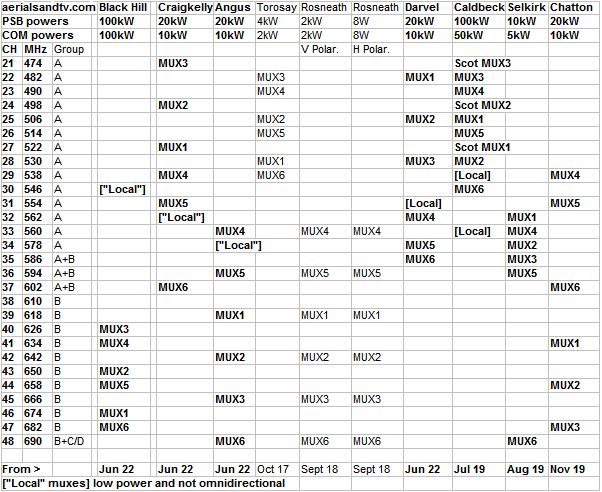
Black Hill transmitter's channel allocations
For the most up to date MUX to channel allocations etc put this postcode ML7 4NZ into the Freeview checker.
Also see Scottish Central region Freeview transmitters.
The guide below also includes the same information for other potentially co-receivable transmitters within Black Hills coverage area, namely Craigkelly, Angus, Torosay, Rosneath, Darvel, Caldbeck, Selkirk, and Chatton. The Channel Allocation Guides can be very useful in the diagnosis of co-channel interference problems and can also be invaluable if you are trying to find a spare channel for a modulated output (e.g. for a Sky box or CCTV system) to be added to your TV setup/distribution system without suffering from co-channel.
Also check Black Hill’s sixty four (including Torosay’s twenty two) smaller relays.
The frequencies given are for (most) digital MUXES, for analogue channels deduct 3MHz.
I suspect that Caldbeck may well have a restricted radiation pattern in a Northerly direction and that “Caldbeck Scotland” will act as a supplementary transmitter (on different frequencies) only transmitting in this direction.