
TV transmitter channel allocations
Subject list :
Sample channel allocation table (for Crystal Palace = London area)
Blank channel allocation table
Sheffield Historic pre DSO channel allocation table (analogue + digital)
Uses of transmitter channel allocation guides
The frequencies given are for (most) digital MUXES, for analogue channels deduct 3MHz.
And yes, analogue still exists, e.g. a modulated output from your CCTV
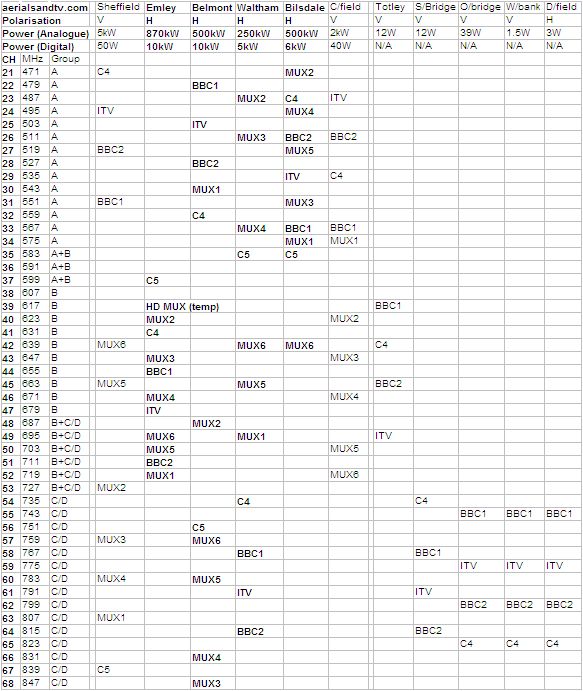
Most of the transmitter pages on this site (e.g. Crystal Palace) have their own Channel Allocation Guides, but because the coverage areas of most main transmitters are so large they do not represent the receivable frequencies in a particular geographical area in the same way the linked to "Sheffield transmitter allocation guide"does. The latter table lists the broadcast channels for all the receivable TV transmitters around Sheffield. Apart from the guides obvious interest to those in the Sheffield area it serves as a graphical reminder just how crowded the RF (Radio Frequency) spectrum is, note how the planners have “dovetailed” the various broadcast frequencies together in an attempt to minimise co-channel interference. Clicking on the latter link will also give some advice on how to combat the problem.
The various Channel Allocation Guides can be invaluable if you are trying to find a spare channel for a modulated output (e.g. for a Sky box or CCTV system) to be added to your TV setup/distribution system without suffering from co-channel.
The five transmitters on the right hand side of the table below are all small repeaters with relatively small outputs and coverage patterns, thus the potential for co-channel between them is (theoretically....) small. One must remember that Sheffield is a hilly city (the resultant rivers, in the low lying areas, helping to explain why the steel making industry developed here) and so there are relatively few locations where more than one or two of the small repeater transmitters would be co-receivable.
Blank Transmitter Channel Allocation Guide
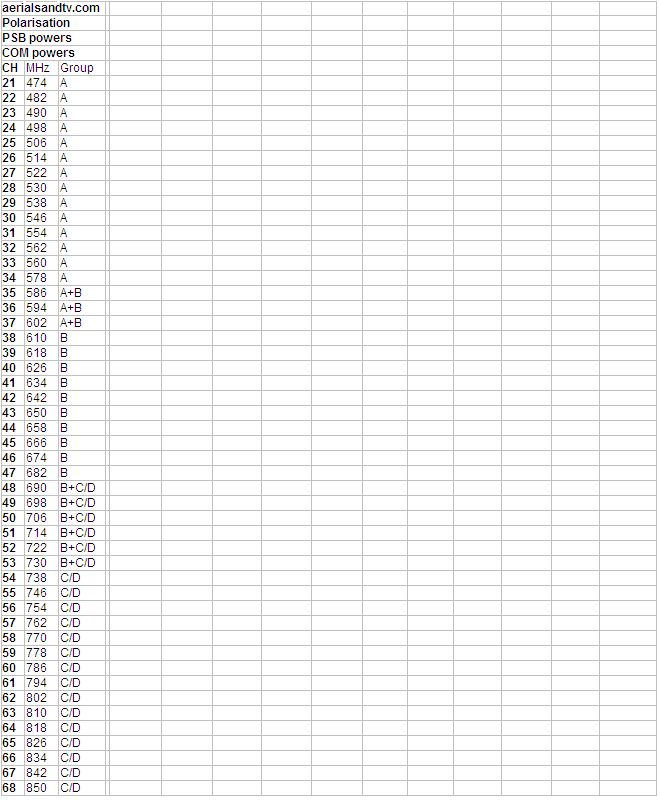
Below is a blank TCA for printing out to assist with finding a suitable channel to add a signal from an RF modulator. Also read the article on Selecting an RF modulated channel.
Right click on table then click "Print Picture" (or "Save picture", then print it) .
The frequencies given are for (most) digital MUXES, for an analogue channel deduct 3MHz.
Below, for historical interest, is the last Channel Allocation Guide for the Sheffield area whilst analogue and - low power - digital were both being transmitted, i.e. the situation on the 2 Aug 2011 the day before Belmont commenced its switchover. It’s a bit crowded is it not……. The frequencies given below are for analogue channels MUXES, for digital analogue channel add 3MHz.[Link]