

ATV aerial gain tests : all the gain curves
The gain curves are conservative estimates, but I bet they’re not that far out.........
One things for sure, they’re all accurate relative to each other, which is what matters !
Note these curves are in dBd, that is gain compared to a half wave dipole, NOT (the dishonest ? ) dBi....
- Typical Contract 10 gain curves
- B group Contract aerial curves
- A group gain curves and comparisons
- B group gain curves and comparisons
- C/D group gain curves and comparisons
- K group gain curves and comparisons
- E group gain curves and comparisons
- Wideband / T group gain curves and comparisons
- Small Log Periodic aerial gain curves
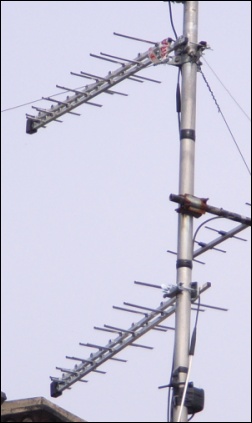
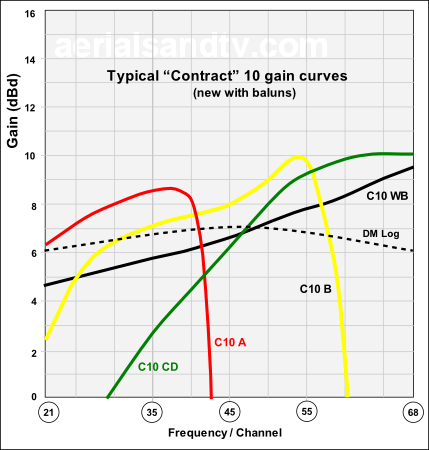
Just how much gain do you get from a 10 element Contract aerial ?
These were relatively good quality Contracts (they had baluns) and it cannot be overstressed that some Contract aerials’ performance can be very inconsistent (see gain graph below....), and this is particularly the case outside of their designed for group.
Note that the A group curve is that for post 1995 aerials, when the A group was extended up to CH 37 from CH 34, see history and evolution of British TV aerial groups. Thus the response curve for aerials fitted prior to this date would be about three channels down.
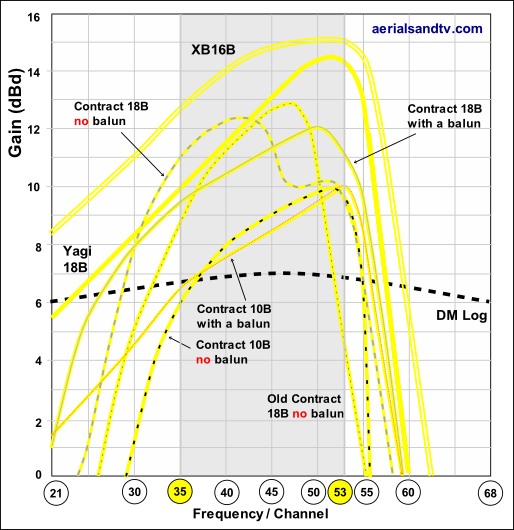
Testing decent quality aerials is all very well, but what about the cheapies that many people may already have up, or be put up by a tight arse aerial installer ?
Above we have two Contract 10Bs, an old Contract 18B (possibly 20 to 30 years old ?), two Contract 18Bs, plus the Yagi18B and the XB16B which we sell.
I was particularly interested to find out how much difference a balun made to the performance of an aerial and in the above tests the two Contract 10s are identical save for one having a balun and the other not. From those curves, and the others come to that, it can be seen that a balun does seem to have an effect on gain, particularly outside the aerials designed for band.
It will be noted that the gain of the old Contract 18B was dipping way before even CH53, which is the top of the B group. As can be seen in this article the B group used to finish at CH51, but even so, the aerial is dropping off too early.
Now, all aerial gain curves have bumps and dips in them, so on this site (and in fact all published aerial gain curves....) they are smoothed off for clarity, but the huge dip in the gain of the Contract 18B without a balun is of a different order altogether. This is typical of some Contract type aerials, beware.
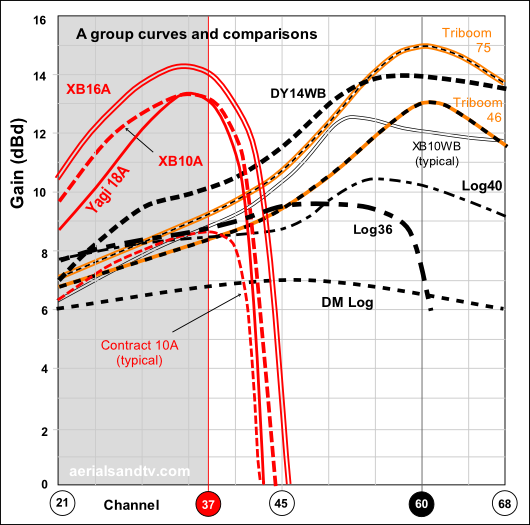
ATV's A group TV aerial gain curves compared to other relevant antennas.
Also see Tri Boom aerial gain curve.
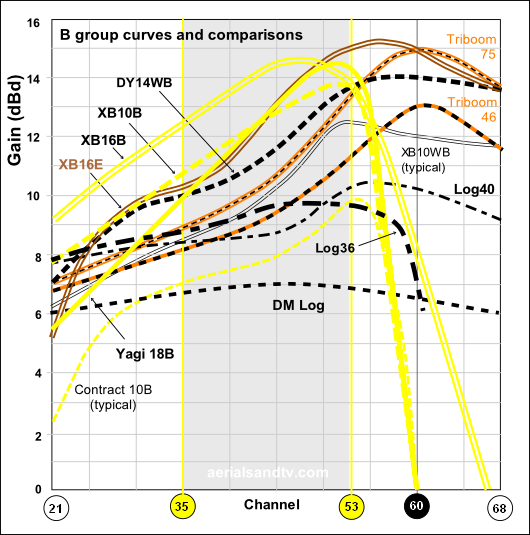
ATV's B group TV aerial gain curves compared to other relevant antennas.
Also see Tri Boom aerial gain curve and B group Contract aerial curves
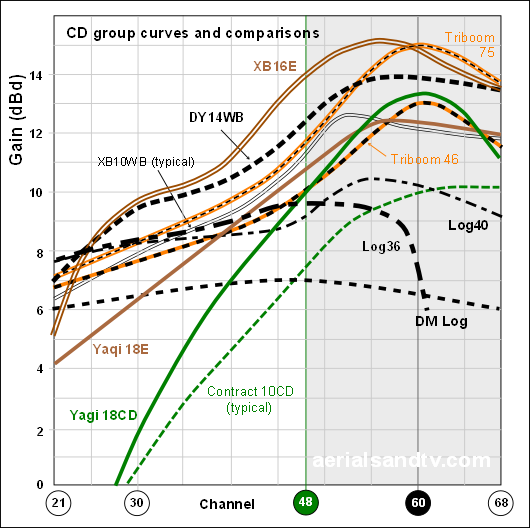
C/D group TV aerial gain curves compared to other relevant antennas.
Also see Tri Boom aerial gain curve.
The CD group is now obsolete, but there are still thousands up on people’s houses so this graph is still relevant !
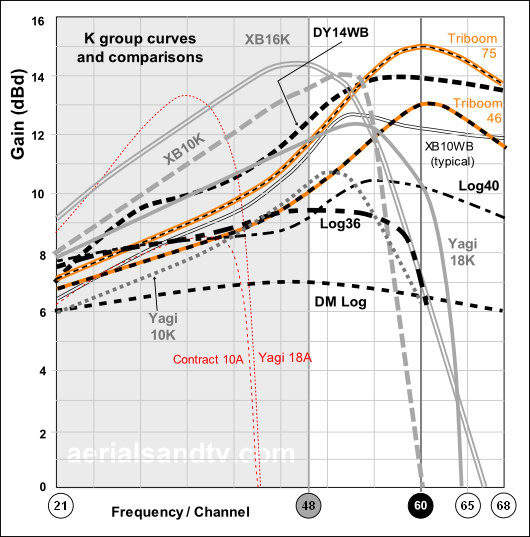
ATV's K group TV aerial gain curves compared to other relevant antennas.
Also see Tri Boom aerial gain curve.
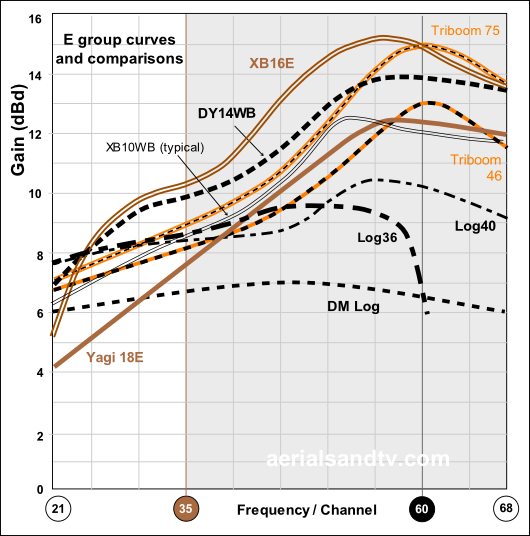
ATV's E group TV aerial gain curves compared to other relevant antennas.
Also see Tri Boom aerial gain curve.
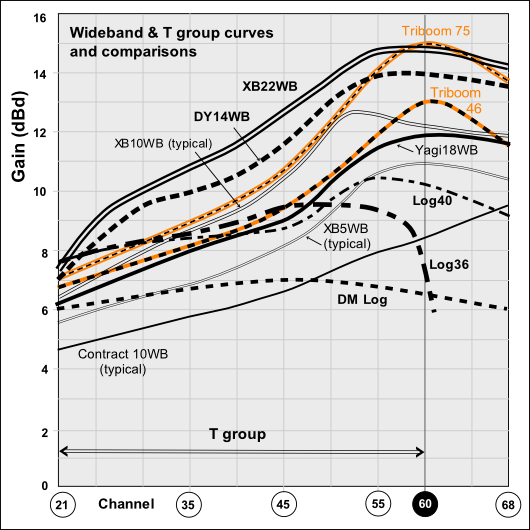
ATV's wideband / T group TV aerial gain curves compared to other relevant antennas.
Also see Tri Boom aerial gain curve.